Backend services
Create Postgres, Valkey, OpenSearch, or object storage as a standalone resource or attach it to a project.
SproutOS provides four managed backend service kinds: Postgres, Valkey, OpenSearch, and S3-compatible object storage. Open Databases to create and manage all four; the navigation name covers more than relational databases.
Attached and standalone services
When creating a service, choose a project or leave Project set to Standalone.
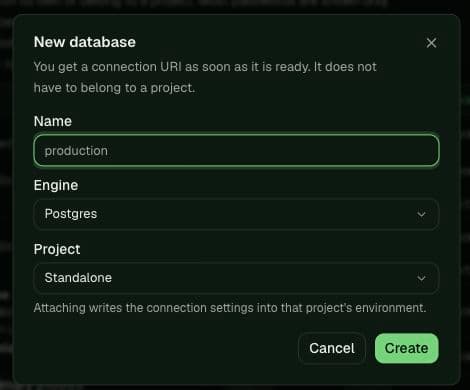
- Attached means SproutOS associates the service with one deployable project and writes the connection settings into that project's encrypted environment.
- Standalone means the service belongs to the organization without an automatic project association. It remains a SproutOS-managed service. Copy its connection value into each authorized project yourself.
Choose standalone when several projects need the same data store, when a database is operated independently from an application release, or when OAuth users receive their own service. Choose attached for the common one-application, one-service case.
Pick the service by workload
- Postgres stores relational application data and supports disposable branches for safe schema work.
- Valkey provides cache and queue primitives; BullMQ projects also receive a tenant prefix.
- OpenSearch provides tenant-scoped search indexes.
- Object storage stores mutable files through an S3-compatible API. It is private by default, supports presigned browser transfers and optional anonymous object reads, and uses multipart uploads when an individual request would exceed 64 MiB.
Services are independent resources. Deploying application code does not recreate them, and rolling back a deployment does not roll back their data.
Capture and rotate credentials safely
Postgres, Valkey, and OpenSearch connection URIs are displayed only when created or rotated. SproutOS stores a verifier, not a recoverable plaintext copy. Save the value directly into an encrypted environment target and do not put it in source control, logs, screenshots, or shell history.
If the value is lost, rotate it. Rotation revokes the previous credential, so update every consumer together. Object storage is the exception: its derived credential can be viewed again, although rotation still invalidates the old one.
Know the sandbox boundary
Hosted Agent sandboxes intentionally do not receive production runtime secrets. When an agent needs a database, it requests a disposable Postgres branch with a scoped action token. This prevents a code-editing session from silently gaining access to production data. See Agent sandboxes.